
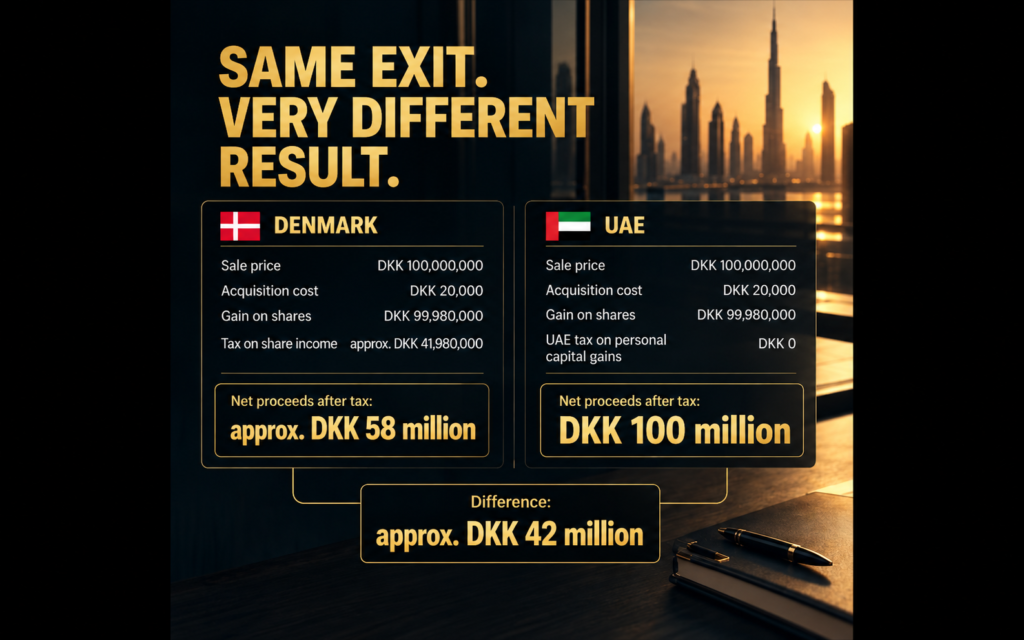
Two founders each sell their company for DKK 100 million. Both own their company personally. Yet one may be left with approximately DKK 58 million, while the other may keep the entire sale price of DKK 100 million after tax on the sale itself.
The difference may lie, among other things, in where the owner is tax resident while the company is being built up and increasing in value.
But that doesn’t mean you can just move to Dubai shortly before a sale and achieve the same result. If the company has already achieved significant value, the Danish rules on relocation tax can be crucial.
An exit for 100 million DKK: Denmark compared to the UAE
Let’s take a simplified example.
We compare a founder who is fully taxable in Denmark with a founder who has built his business as a tax resident in the UAE without Danish tax liability or outstanding Danish relocation tax on the ownership shares.
Both own their company personally and sell their shares or stakes for 100 million DKK.
The purchase price is DKK 20,000, and the tax gain is therefore DKK 99,980,000.
| Denmark | UAE | |
|---|---|---|
| Selling price | 100,000,000 DKK. | 100,000,000 DKK. |
| Purchase price | 20,000 kr. | 20,000 kr. |
| Gain | DKK 99,980,000 | DKK 99,980,000 |
| Tax on the owner’s gain | DKK 41,979,690 | 0 kr.* |
| Net proceeds after tax | 58,020,310 kr. | *100,000,000 DKK. ** |
In Denmark, share income is taxed at 27% of the first DKK 79,400 and 42% of the remainder in 2026. The calculation assumes an unmarried owner with no other share income or offsetable losses.
In the example, this results in a difference of almost DKK 42 million in tax on the share sale itself.
*The UAE example assumes that the gain qualifies as personal investment income and that no other country has the right to tax the sale. Trading costs are ignored. The example concerns the taxation of the owner upon sale of the ownership shares and not the ongoing taxation of the company.
Why can a personal share sale be free of UAE tax?
Under UAE Corporate Tax rules, a natural person’s Personal Investment income is generally not considered income from Business or Business Activity when the relevant conditions are met.
Gains on the sale of personally owned investments may therefore fall outside of UAE Corporate Tax.
This means that a private individual’s sale of personally owned shares or units can, depending on the circumstances, be carried out without UAE tax on the gain.
However, this requires a specific assessment.
A distinction must be made between personal investment activity and activity that is in the nature of a business. The tax treatment therefore depends on the owner’s specific circumstances and the nature of the investment and activity.
It is also important to distinguish between the owner’s sale of the shares and the company’s sale of the company or its assets.
For example, if the company sells its assets, or if a holding company sells the ownership interests in a subsidiary, this is a different structure, and the tax analysis will therefore also be different.
Can you just move to Dubai before the sale?
The short answer is no.
If you own shares or units when your Danish tax liability ends, the move may trigger Danish relocation tax on the unrealized gain on the shares.
This means that under certain conditions, Denmark treats the increase in value for tax purposes as if the ownership shares had been sold in connection with the move – even if you actually continue to own the company.
If the company has already increased significantly in value, the latent Danish tax can therefore be very large.
There may be a possibility of deferring the payment of the vacating tax. However, a deferral is a postponement of the payment – not necessarily a waiver of the tax. A later actual sale of the ownership shares may therefore have an impact on the deferral balance and trigger payment.
If you move the company before the value of the company has increased significantly, you can still benefit from the difference in taxation between Denmark and the UAE.
Read more about Exit taxation of shares and holding companies upon relocation.
A UAE residence visa does not automatically end Danish tax liability
It is also not sufficient to simply obtain a UAE residence visa, Emirates ID or an address in Dubai.
Whether the full Danish tax liability has ceased is determined according to Danish tax rules. Here, the availability of housing in Denmark and the specific circumstances surrounding the move may be of decisive importance.
You can therefore physically move to Dubai and still be fully liable to tax in Denmark.
This is precisely why immigration and taxes should be treated as two different issues.
Planning should begin while value is being created
For a founder who is already considering an international move, taxes should be included early in the decision-making process.
The relevant time to review the structure is typically not a few weeks before an expected sale. It can be several years earlier – for example, before major value increases, a capital raise or concrete sales negotiations.
The more value that has already been created while the owner is liable to tax in Denmark, the greater the significance of the Danish relocation tax rules.
An early review should include, among other things:
- the ownership structure and any holding companies,
- the value of the ownership shares at the time of vacating,
- the consequences of Danish relocation tax,
- the conditions for cessation of Danish tax liability,
- the owner’s tax position in the UAE,
- the company’s tax domicile,
- the location of the company’s management and activities, and
- the consequences of a later sale.
See also why the company structure should be reviewed before moving to Dubai.
Taxes should of course not be the only consideration when moving internationally. Family, customers, employees, business operations and quality of life can be just as crucial.
But when significant values have been built up – or are expected to be built up – in a company, tax timing can have very significant financial significance.
Frequently Asked Questions
Is selling a business tax-free in Dubai?
A personal sale of ownership shares may, depending on the circumstances, fall outside of UAE Corporate Tax as personal investment income.
This does not mean that every sale of a business in the UAE is tax-free. The tax treatment depends on, among other things, who is selling, what is being sold, and whether other countries have taxing rights.
Can I avoid Danish tax by moving to Dubai before the sale?
Not necessarily.
A move from Denmark may trigger Danish relocation tax on the unrealized gain on your ownership shares. If the company has already achieved significant value before the move, a significant Danish tax position may have already arisen.
The timing of the move can therefore be crucial.
Does a holding company eliminate taxes upon an exit?
A holding company may, under the relevant conditions, sell ownership interests in a subsidiary without corporate tax on the capital gain itself.
But the proceeds then belong to the holding company – not the owner personally.
The personal taxation upon later payment of the money and the consequences of a possible move out must therefore be assessed separately.
When should I get counseling?
Preferably before the move and before a sale becomes concrete.
When the value of the company, the buyer and the terms of the transaction have already been determined, the options for organizing the ownership structure and vacating the premises may be significantly more limited.
For founders with a growing business, it may therefore be relevant to have the structure assessed long before a sale is actually planned.
Are you considering a move to Dubai or a future exit?
At Friis Legal, we advise business owners on relocation tax and cessation of Danish tax liability, including in connection with moving to the UAE.
We help clarify the consequences based on your ownership structure, the value of the company and your future plans, so that the tax implications can be assessed before a move or business sale is completed.
Book an initial consultationso that we can clarify your consulting needs and the framework for a specific assessment.
The article is based on 2026 rules and is general information. The specific tax treatment depends on, among other things, ownership, tax liability, company structure and the specific content of the transaction.